I've decided to change the name of my blog, after finding out a bit more about the word 'gaijin'.
Gaijin is a short-hand term - the proper word is gaikokujin, using the characters 外国人, which means (outside - country - person, which translates very easily as foreigner). But the shorter word of gaijin, it seems, is much less polite.
Times I've heard people use 'Gaijin':
1) Sitting on the train one day, with three empty seats around me. A group of three middle-aged Japanese people get on to the busy train, but in the rush for seats one of them stutters over taking the seats next to me. Her husband pushes her into the seat, and sits down opposite her. He asks her in Japanese why she didn't sit down, and asks if it was because of the 'へんな外人’ (henna gaijin - weird foreigner) sitting beside her. Which I considered a little unjustified, sitting as I was in a suit quietly reading a book. I stared him in the eye. '日本語をわかるの?’ roughly asking me if I understood Japanese. 'うん、わかる,’ - yes I understood. No one said much after that.
2) Walking in the street in central Fukuoka, a crazy old granny shouted at me with a chipboard voice, "外人、外人、背が高いね!" - 'foreigner, foreigner, you're tall aren't you!"
I must stress that these are very isolated incidents, and the people I've met here are on the whole the politest I've ever met. But when the more xenophobic side filters out, it generally gets associated with the term 'gaijin'. I thought of our English equivalents, as when in the past westerners have used shortened terms like 'Japs' or 'Nips' - or at worst 'pakis'. 'Gaijin' is certainly not that extreme, but the connotations aren't great.
So, I've decided to shift this blog to Nippon Lamford. Nippon is the Japanese name for Japan, as is Nihon, the two words being largely interchangeable. But Nippon Lamford sounds better, so that is what it shall be...
Saturday, 12 May 2007
Friday, 13 April 2007
Ouragan de Fleurs - Butoh performance
 'Ouragan de Fleurs' - 'Hurricane of Flowers' a performance by the Fukuoka Seiryukai, featuring five talented butoh dancers, and me.
It would be performed in Fukuoka at the French Institute, after my teacher and the gang had taken the piece to Paris at the end of March.
They didn't like Paris that much. Too dirty, too rude, too many druggies. Just not Japan.
Actually, disillusionment with Paris is a common problem among Japanese visitors. So much so that the embassy there has opened an emergency helpline for Japanese tourists, suffering deep culture shock at the destruction of their idealised images of the lovers' city. [Original story]
There was a similar sense of culture shock in the making of the piece ('creative differences' - people finding ever move creative ways to differ with each other). But by the time of the performance, all was calm in the Seiryukai camp.
Preparations were rather last minute - rehearsals continued until 15 minutes before the start. The last time we practised the final scene (pictures below), the four of us collapsed in a sprawling heap. Should we fall over, the back-up plan was to make it into 'a falling dance'.
But with the lights set and the audience ready to come in, there was calmness back stage. The Japanese dancers and stage crew called out to each other in chorus "Yoroshiku Onegaishimasu" - the polite Japanese way of asking for a favour. Rather different to the western dark humour of 'break a leg'.
The audience in their seats (well, on their cushions), the lights down, and it began.


Thanks to Brendan (again) for the photos.
Saturday, 31 March 2007
Hana-Mi (花見)
Hana Mi (literally, 'flower viewing') is one of the great cultural traditions of Japan.
Around the end of March, the Cherry trees burst into full bloom. They start in the far south, and move up Japan in a wave of flowers over the following week. So great is the custom of viewing the flowers, the Japanese weather agency publishes official forecasts of the specific blooming dates for each region. When the forecasters realised their prediction was out by a couple of days, they had to go on national TV and make a full apology, bowing and scraping in the way that only the Japanese can.
Sakura, the Japanese Cherry Blossom, is repeatedly fêted throughout Japanese culture, from the most austere of Haiku to the cheesiest of J-pop lyrics.
When those flowers finally emerged, it became perfectly clear what all the fuss is about.
 The bloom is radiant and lovely, to a gratuitous degree.
WHY be that pretty?
Well, reason or no, the effect is wonderful, and manna to the soul.
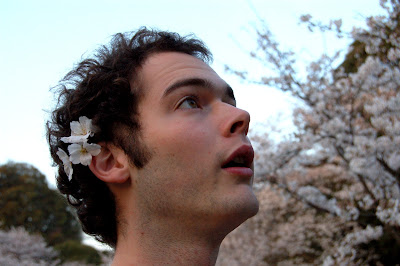
The Japanese being one of the most civilised of peoples, they take the time to sit and watch the flowers, in viewing sessions known as Hana Mi. They have a long history; The Tale of Genji, written in the early eleventh Century, tells of flower viewing sessions much akin to Hana Mi.
Despite the traditions of Zen austerity that remain as one strand of Japanese culture, they are also extraordinarily good at enjoying the pleasures of life.
They do not just sit and watch in silence, in raptures of aesthetic wonder.
Instead, they get pissed.
Large groups, whether of friends, work colleagues, communities, sit on spread blue tarpaulins, and drink themselves into a flower covered alcoholic oblivion.
Keen to sample as much of Japanese culture as possible, we were keen to emulate our hosts example.
This was made easier by my discovery of a new, special can size of Asahi Beer.

A can of beer, bigger than an adult's head. God bless the Japanese.
At night, the parks of dense Cherry Blossom are floodlit and packed with revellers. Viewing cherry blossom at night is called 夜桜 (Yozakura); when a culture produces a single word to describe something, it shows that thing is important to those people (You may notice we don't have a single word for 'watching cherry blossom at night' in English.)
[Incidentally, my favourite untranslatable word is 'Uitwaaien' - Dutch for 'to walk in the wind for fun'.]
The week after our own Hana Mi, I was in Kyoto and found this beauty, its boughs heavily laden with blossom, standing strong and still, drawing all eyes to its treasures.
 Sakura is not just famous because of its great beauty. It also holds a great emotional draw because of its fleeting lifespan. For a week, the blossoms grow. Then they stand, proud and brilliant in full bloom, for one week more. And after that, it is all downhill.
 The blossom flies off in the wind. The ground becomes ankle deep in drifts of discarded cherry blossom.
A couple of weeks, and then it is all gone. Plain green leaves replace the bright blossom. The blossom on the floor shrivels to yellow dust.
In Japanese culture, the blossom is seen as the ultimate example of 物の哀れ ('Mono no aware'). Various translations exist, but it roughly means 'the pathos of the fleeting nature of existence'.
One week it is bright and brilliant, the next week it is gone.
It is a powerful reminder of the brevity of our time here.
So in the mean time, let's have a drink.
Around the end of March, the Cherry trees burst into full bloom. They start in the far south, and move up Japan in a wave of flowers over the following week. So great is the custom of viewing the flowers, the Japanese weather agency publishes official forecasts of the specific blooming dates for each region. When the forecasters realised their prediction was out by a couple of days, they had to go on national TV and make a full apology, bowing and scraping in the way that only the Japanese can.
Sakura, the Japanese Cherry Blossom, is repeatedly fêted throughout Japanese culture, from the most austere of Haiku to the cheesiest of J-pop lyrics.
When those flowers finally emerged, it became perfectly clear what all the fuss is about.
 The bloom is radiant and lovely, to a gratuitous degree.
WHY be that pretty?
Well, reason or no, the effect is wonderful, and manna to the soul.

The Japanese being one of the most civilised of peoples, they take the time to sit and watch the flowers, in viewing sessions known as Hana Mi. They have a long history; The Tale of Genji, written in the early eleventh Century, tells of flower viewing sessions much akin to Hana Mi.
Despite the traditions of Zen austerity that remain as one strand of Japanese culture, they are also extraordinarily good at enjoying the pleasures of life.
They do not just sit and watch in silence, in raptures of aesthetic wonder.
Instead, they get pissed.
Large groups, whether of friends, work colleagues, communities, sit on spread blue tarpaulins, and drink themselves into a flower covered alcoholic oblivion.
Keen to sample as much of Japanese culture as possible, we were keen to emulate our hosts example.
This was made easier by my discovery of a new, special can size of Asahi Beer.

A can of beer, bigger than an adult's head. God bless the Japanese.
At night, the parks of dense Cherry Blossom are floodlit and packed with revellers. Viewing cherry blossom at night is called 夜桜 (Yozakura); when a culture produces a single word to describe something, it shows that thing is important to those people (You may notice we don't have a single word for 'watching cherry blossom at night' in English.)
[Incidentally, my favourite untranslatable word is 'Uitwaaien' - Dutch for 'to walk in the wind for fun'.]
The week after our own Hana Mi, I was in Kyoto and found this beauty, its boughs heavily laden with blossom, standing strong and still, drawing all eyes to its treasures.
 Sakura is not just famous because of its great beauty. It also holds a great emotional draw because of its fleeting lifespan. For a week, the blossoms grow. Then they stand, proud and brilliant in full bloom, for one week more. And after that, it is all downhill.
 The blossom flies off in the wind. The ground becomes ankle deep in drifts of discarded cherry blossom.
A couple of weeks, and then it is all gone. Plain green leaves replace the bright blossom. The blossom on the floor shrivels to yellow dust.
In Japanese culture, the blossom is seen as the ultimate example of 物の哀れ ('Mono no aware'). Various translations exist, but it roughly means 'the pathos of the fleeting nature of existence'.
One week it is bright and brilliant, the next week it is gone.
It is a powerful reminder of the brevity of our time here.
So in the mean time, let's have a drink.
Friday, 30 March 2007
The Best Meal I Have Ever Eaten
The great surprise of the Okunoyu Ryokan in Kurokawa Onsen (see previous post), was the wonderful food. It now ranks as the tastiest meal I've ever eaten, and so is worthy of a blog post in its own right. Seizing the luxurious option of having our dinner served to us in our own tatami room, we arrived to find a banquet spread across our table...

It was like a Greatest Hits Compilation of Japanese food. And, as with all Japanese meals, the whole lot was served at once, allowing you to pick and choose whatever took your fancy.
First, light juicy Tofu, fresh, springy mushrooms, sweet pumpkin and sharp pickles.

A Mediterranean creamy salmon, fresh scallop, soft sweet potato, and a plum so sharp it sucked the juices out of your mouth.

Sashimi - raw, fresh fish in soft cuts that melt in your mouth.
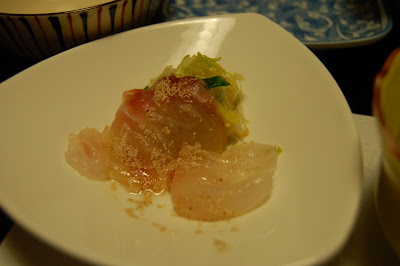
Salmon sashimi - with sliced spring onion, grated daikon (Japanese radish), and enough wasabi to blow your nose off.

Light, fluffy Tempura - essentially fried vegetables and seafood, but unlike any frying we know in England. Juicy but not damp, succulent but not chewy, and lightly dusted with seasonings.

Beef sashimi - raw, succulent; simply floated away as you chewed, and you floated with it. The best of the lot.

And then, a light touch of novelty.

 Resting on a small, iron stove, a wire basket cups a single portion of Nabe - Japanese vegetable stew. With a click lighter, you set the little paraffin tub burning, and let it heat your stew as you picked your way through the many, many dishes. Just as the paraffin ran out and the stew came to the boil, it was perfect for eating. Of course the vegetables were super fresh and delicious, but the soup was unbelievable. The thick, floating gobbets of pork fat (that us westerners would feel obliged to cut off and throw away) saturated the juice would a beautiful, heady, soft flavour.
And then, the final, gratuitous, course. When you're already so full that you can't even eat the soft, fluffy rice that arrived Chinese-style at the end of the meal, well, you always have space for dessert, right?

Absolutely stuffed.

Two of the simplest, most powerful pleasures in life; beautiful food, and powerfully hot baths.
It made me smile a lot.

It was like a Greatest Hits Compilation of Japanese food. And, as with all Japanese meals, the whole lot was served at once, allowing you to pick and choose whatever took your fancy.
First, light juicy Tofu, fresh, springy mushrooms, sweet pumpkin and sharp pickles.

A Mediterranean creamy salmon, fresh scallop, soft sweet potato, and a plum so sharp it sucked the juices out of your mouth.

Sashimi - raw, fresh fish in soft cuts that melt in your mouth.

Salmon sashimi - with sliced spring onion, grated daikon (Japanese radish), and enough wasabi to blow your nose off.

Light, fluffy Tempura - essentially fried vegetables and seafood, but unlike any frying we know in England. Juicy but not damp, succulent but not chewy, and lightly dusted with seasonings.

Beef sashimi - raw, succulent; simply floated away as you chewed, and you floated with it. The best of the lot.

And then, a light touch of novelty.

 Resting on a small, iron stove, a wire basket cups a single portion of Nabe - Japanese vegetable stew. With a click lighter, you set the little paraffin tub burning, and let it heat your stew as you picked your way through the many, many dishes. Just as the paraffin ran out and the stew came to the boil, it was perfect for eating. Of course the vegetables were super fresh and delicious, but the soup was unbelievable. The thick, floating gobbets of pork fat (that us westerners would feel obliged to cut off and throw away) saturated the juice would a beautiful, heady, soft flavour.
And then, the final, gratuitous, course. When you're already so full that you can't even eat the soft, fluffy rice that arrived Chinese-style at the end of the meal, well, you always have space for dessert, right?

Absolutely stuffed.

Two of the simplest, most powerful pleasures in life; beautiful food, and powerfully hot baths.
It made me smile a lot.
Thursday, 29 March 2007
My search for The Best Bath in Japan II
Great Baths of Japan - Kurokawa Onsen - Shinmeikan
 Far inland, in the mountainous regions around Mount Aso (the largest volcanic caldera in the world), there are a few small villages that take full advantage of the natural geothermal activity. Unlike the neon-trash onsen towns like Beppu on the East coast, all cheap bars and tourist traps, they are quiet, green, and exist for only one purpose - onsen.
And these onsen are special. Travelling with my girlfriend, we splashed out on a night of luxury in a fancy ryokan called 奥の湯 (Okunoyu - roughly, 'the hot water deep inside'). I normally tour on a budget - hostels and cheap hotels etc etc. But this place actually sent a van down to pick us up from the coach stop. And carried our luggage upstairs for us. And served us dinner in our room. Not used to such things...
Well, the star attraction of this ryokan was the steaming rotemburo, built from rough rocks on the edge of a cool, flowing, tree-lined river. We sat and soaked, listened to the running water, looked at the trees. There's actually not a lot you can do in a bath. Which is perhaps their greatest advantage over Outside-Bath Life.
And that is how our lives divided for our 24hours in Kurokawa Onsen. Intense periods of In-Bath Living, followed by recuperative periods of Outside-Bath Existence, necessary to unprune your skin and cool your core body temperature to below 60 Celsius.
 But a further novelty bath awaited us. The Shinmeikan Ryokan is extremely popular, but going at lunchtime allowed us to avoid the crowds and have it to ourselves. This place put the normal Rotemburo experience right on its head (not that the Rotemburo experience is ever that normal). Rather than go indoors to get changed, before proceeding naked to the great outdoors, here you got naked outside, before heading inside. Lacking the usual ryokan dressing gowns, the trip to the onsen necessitated a naked scamper along the pathway (this photo was taken from the (extremely public) street, across the river).
 Once you walked through the dark, imposing entrance, you find yourself in a steam-filled, ill-lit tunnel. Your clothes are getting damp from standing in a hot cloud, and your skin starts to sweat from the heat. Jeans and T-shirt stuffed into a wicker basket, and you step into the bath and begin to wade, half-blind, hoping not to trend on anyone or anything. Not sure on the etiquette for holding your arms out before you when blind in a bath...
And so we sat, fortunately alone. In a bath. In a cave. By a river. In Japan.
I'd particularly recommend this to mid-bath singers - great acoustics in a cave.
Even I sang. And that really doesn't happen everyday.
N.B. As with previous Best-Bath-Hunt post, I'd always opt for the rubber duck over the camera as a bath-time plaything. And so, appreciations to the internet for its copyright-free bounty (ie not my pictures).
Saturday, 24 March 2007
My search for The Best Bath in Japan I
温泉(ONSEN) - (n.) One of Japan's great contributions to human civilisation. Due to its high level of subterranean thermal activity, hot water naturally bubbles up all over the place. Put that hot, mineral-rich water in a bath, and you have an Onsen.
露天風呂(ROTEMBURO) - (n.) The Onsen taken to another level of perfection - outside bathing.
NB. Due to the suicidal nature of mixing digital photography and hot water, I've been forced to turn to the generosity of the internet for these photos...
Great Baths of Japan - Sakurajima - Furusato Onsen
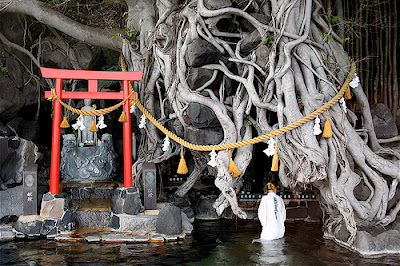
On the far southern tip of what could be called mainland Japan, Sakurajima sits, smoking belligerently. A large and very active volcano, it sporadically sends vast clouds of smoke and ash rolling up into the atmosphere. It used to be an island, but in 1914 a great eruption spilled enough lava to connect it to Kyushu.
As the lumpen black rocks boulder down to the sea, geothermally heated water bubbles up to the surface. And right between this great volcano and the Pacific Ocean, this water feeds a very unusual onsen.
 In such a unusual and powerful location, it makes perfect sense that it became the site of a Shinto shrine (the native religion of Japan). From the overhanging cliff, the roots of an ancient tree drop down into mid-air, with heavy black boulders caught awkwardly in its crooked roots hanging over the water. In the crevice underneath this natural mobile, statues stand vigil barely a foot from the water. You can wade right up to them, put your head under the cobwebbed roots and brutal boulders, stand in their shade and hope they don't fall. Certainly one of the strangest temples I've ever been in. Out of respect for the shrine, you have to wear a Yukata (Japanese dressing gown) in the bath.
As I lay back in the steaming hot waters, English places of worship seemed a very long way away. How could I even compare the hard, drafty pews of ascetic Protestantism to this balmy experience. Of course, Japanese religion certainly can do ascetic - think Zen monks up at dawn to meditate, with a Master hitting them with sticks whenever they showed signs of drooping, or a Shugendo Monk (allied to Shinto) meditating for hours under a freezing waterfall. But Shinto seems, on the whole, to be rather more keen on appreciating the good things of life.
With your back to the shrine, the Pacific Ocean spreads out before you. When I was there, the rain was heavy, the wind cold, and the waves strong. They crashed onto rough rocks with a huge weight, rendering the 'no swimming' signs rather unnecessary. I took turns between immersing myself in the hot waters until they proved unbearable, and then standing out on the rocks and feeling the heat drain from my skin in seconds. Then back in the water for another 5minute soak. Repeat until beaten by the elements into a heady state of relaxation, as you watch the seabirds fly overhead and listen to the waves barely 5m away.
 Two great black rocks lie between the sea and the bath, and between them is strung a thickly twisted rope, on which is hung heavy paper flashes in a lightning design. It combines all the great Shinto elements - water, rock, wood, paper, rope. Only one thing was missing - and then, in the sinking gloom, they lit the braziers, and we bathed by firelight.
露天風呂(ROTEMBURO) - (n.) The Onsen taken to another level of perfection - outside bathing.
NB. Due to the suicidal nature of mixing digital photography and hot water, I've been forced to turn to the generosity of the internet for these photos...
Great Baths of Japan - Sakurajima - Furusato Onsen

On the far southern tip of what could be called mainland Japan, Sakurajima sits, smoking belligerently. A large and very active volcano, it sporadically sends vast clouds of smoke and ash rolling up into the atmosphere. It used to be an island, but in 1914 a great eruption spilled enough lava to connect it to Kyushu.
As the lumpen black rocks boulder down to the sea, geothermally heated water bubbles up to the surface. And right between this great volcano and the Pacific Ocean, this water feeds a very unusual onsen.
 In such a unusual and powerful location, it makes perfect sense that it became the site of a Shinto shrine (the native religion of Japan). From the overhanging cliff, the roots of an ancient tree drop down into mid-air, with heavy black boulders caught awkwardly in its crooked roots hanging over the water. In the crevice underneath this natural mobile, statues stand vigil barely a foot from the water. You can wade right up to them, put your head under the cobwebbed roots and brutal boulders, stand in their shade and hope they don't fall. Certainly one of the strangest temples I've ever been in. Out of respect for the shrine, you have to wear a Yukata (Japanese dressing gown) in the bath.
As I lay back in the steaming hot waters, English places of worship seemed a very long way away. How could I even compare the hard, drafty pews of ascetic Protestantism to this balmy experience. Of course, Japanese religion certainly can do ascetic - think Zen monks up at dawn to meditate, with a Master hitting them with sticks whenever they showed signs of drooping, or a Shugendo Monk (allied to Shinto) meditating for hours under a freezing waterfall. But Shinto seems, on the whole, to be rather more keen on appreciating the good things of life.
With your back to the shrine, the Pacific Ocean spreads out before you. When I was there, the rain was heavy, the wind cold, and the waves strong. They crashed onto rough rocks with a huge weight, rendering the 'no swimming' signs rather unnecessary. I took turns between immersing myself in the hot waters until they proved unbearable, and then standing out on the rocks and feeling the heat drain from my skin in seconds. Then back in the water for another 5minute soak. Repeat until beaten by the elements into a heady state of relaxation, as you watch the seabirds fly overhead and listen to the waves barely 5m away.
Two great black rocks lie between the sea and the bath, and between them is strung a thickly twisted rope, on which is hung heavy paper flashes in a lightning design. It combines all the great Shinto elements - water, rock, wood, paper, rope. Only one thing was missing - and then, in the sinking gloom, they lit the braziers, and we bathed by firelight.

Monday, 19 February 2007
Koen Debut - 公園デッビュー
*If you don't know what Butoh is, read this previous post first*
Koen Debut (公園デッビュー) is a Japanese phrase that refers to the first time that a new-born baby is paraded in the local park (koen). Its meaning has broadened to refer to any first-time presentation or debut, but it still keeps the element of the naive baby, not quite sure what is going on - an element that seems appropriate for my koen debut...
I knew a month or so in advance that my Butoh Koen Debut would be in February. We perform once or twice at every practice in front of other members of the group, but this would be the first time I would dance in front of a real audience.
 But my actual first time came a week early.
A local bar, a centre for the Fukuoka art scene, was hosting an exhibition of paintings by a local artist. They were large figures of cut board, all crazed hair and technicolour flamboyance, very girly but full of energy. Liking the pieces, we offered to do a performance in the space, and I was volunteered to take part. My understanding of Japanese being at best partial, I just nodded and said 'of course', not entirely sure what I was letting myself in for.
I turned up on the Friday night, and was quickly pinned down by the artist and her make-up friend, who proceeded to paint my eyelids silver and dust me with stars. I got an ivy headband (weirdly reminiscent of a crown of thorns), and bunches of plastic grapes hung from my belt.
Butoh is usually improvised, which makes for unpredictable (and often exciting) performances. Unfortunately, the preparation also has a tendency to be somewhat improvised, which is rather more problematic. As I had brought my laptop, bulging with mp3s, my teacher asked me to put together some music for the performance - twenty minutes before it was due to start. Not the best pre-performance preparation.
Myself and three girls, decked out to the nines, danced solo in turn, before coming together at the end. While the others performed, we stood as statues, flat to the world like one of the paintings. Dancing last of the three, I stood there for half an hour, focussed on the back wall. When I moved and begun to dance, at last I managed to see the crowd - 30 faces, staring up at me from bodies hunched on the floor, watching my every move. The first time I've performed since I was about 9, this was definitely one of those 'how did I get here moments'. The end of the dance saw me dance with Maiko, a Japanese dancer bedecked with flowers. Stuck for ideas, I resorted to crass plagiarism, stealing an idea from a dance performance my father made a long time ago, in which he offered a woman a flower, which she took from him, and devoured whole. - Dad, apologies m(^-^)m
Here, I stole Maiko's flower from her head, and ate it cruelly. She pushed her fingers between my teeth, and took the sodden, half-chewed plastic flower from my jaws. She put it in her own mouth, chewed sourly, and spat it out violently into the audience.
The piece was supposed to end with the three girls surrounding me to form a final tableau. But this being improvised, Maiko preferred to walk straight out into the crowd to her new boyfriend, watching her dance for the first time, and seemingly not best pleased at the random English boy stealing his girl's flower.
I dare say we looked pretty good, much helped by the vibrant pictures. However, somewhat predictably, the tech side was a bit of a mare. More than a mare; actually disastrous. That side is best forgotten - it just makes me feel queasy...
The week after, a second performance, this time in my teacher's house, deep in the countryside in a rickety fishing village called Nakashima.
 Wooden houses, mouldering fishing nets, gumbooted men smoking by the docks. It's a wonderful old place, though the whole lot will be demolished en masse to build a highway.
My teacher's house has a side building with a large performance space upstairs. With one whole wall of windows, it is light and airy, and has slick wooden and tatami floors. Two women, one Australian and one French, live in the building and study with Harada-san. Drop toilets and no central heating make for a basic lifestyle, but one with a suitably wabi/sabi aesthetic.

The performance space is walled on three sides, and backed by large window, over which is hung reams of thick white crepe paper that glows in the sun and billows in the breeze.
On the day of the performance, the house was full and busy from the morning. But the preparations were not physical or mental, culinary. Dish after dish was rustled up - pasta, stew, rice, oden, meat, fish - a veritable banquet.
As this performance would be entirely improvised, and each member of the group would be performing solo, there was nothing in the way of rehearsal to be done. An order was decided, music collated, lighting requested, and then back to the kitchen.
 I was on third, and danced to two pieces by the Kronos Quartet - whirling, wild violin pieces; raw, modern, but finely crafted.
I'd had a lot of back pain, and had noticed a few weeks previous that my right shoulder is higher than my left (the legacy of an unnecessarily dramatic bike accident on my last day in Oxford, and when I fell in the Takachiho Gorge - not so funny now...)
Going for a 'can't beat them, join them' idea, I decided to make the most of how my body felt - hence the lopsided outfit, pulling my body further out of position.
I stood there, on the same stage where we practise a few times a month. It's a low ceiling, a small space, not designed for a body as long as mine; fortunately, it means I can't not fill the stage, which is all for the good.


All the other members of the group performed in turn, though I only have photos of a couple:
 Ikumi
Ikumi

Shin-san, with her recently born sprog - the youngest dancer of the evening (I was the second youngest).
She brings her little baby to practice every Sunday, and he has a fine pair of lungs on him. Left to his own devices for more than a minute, he will bawl to the rooftops for his mummy. She either dances with him, or suckles him comatose before she can dance in peace.
 Maiko, who I danced with the week before.
With a white dress and white face, she could easily have passed for a ghost. She has a very unusual character, normally sweet and kind, but when she dances she becomes something else - wild, intense, broken.
She carried a pair of white feathered wings in her hands, and took three minutes to walk from the edge to the centre of the stage, her faces knotted in total concentration. When she ran out of time and the music stopped, she pounded around the stage, repeating "mada, mada" ['not yet, not yet'].
With the performances over, the party began. The feast was a wonder to behold, and even better to eat. The beer and sake flowed, and the real dancing began. If I learnt anything that night, it was that dancers make good parties. Party Butoh is quite a different affair, closer to burlesque than what had come before.
What is it that the rugby boys say?
'What goes on on tour, stays on tour.'
N.B. Thanks to Brendan for the photos.
Koen Debut (公園デッビュー) is a Japanese phrase that refers to the first time that a new-born baby is paraded in the local park (koen). Its meaning has broadened to refer to any first-time presentation or debut, but it still keeps the element of the naive baby, not quite sure what is going on - an element that seems appropriate for my koen debut...
I knew a month or so in advance that my Butoh Koen Debut would be in February. We perform once or twice at every practice in front of other members of the group, but this would be the first time I would dance in front of a real audience.
 But my actual first time came a week early.
A local bar, a centre for the Fukuoka art scene, was hosting an exhibition of paintings by a local artist. They were large figures of cut board, all crazed hair and technicolour flamboyance, very girly but full of energy. Liking the pieces, we offered to do a performance in the space, and I was volunteered to take part. My understanding of Japanese being at best partial, I just nodded and said 'of course', not entirely sure what I was letting myself in for.
I turned up on the Friday night, and was quickly pinned down by the artist and her make-up friend, who proceeded to paint my eyelids silver and dust me with stars. I got an ivy headband (weirdly reminiscent of a crown of thorns), and bunches of plastic grapes hung from my belt.
Butoh is usually improvised, which makes for unpredictable (and often exciting) performances. Unfortunately, the preparation also has a tendency to be somewhat improvised, which is rather more problematic. As I had brought my laptop, bulging with mp3s, my teacher asked me to put together some music for the performance - twenty minutes before it was due to start. Not the best pre-performance preparation.
Myself and three girls, decked out to the nines, danced solo in turn, before coming together at the end. While the others performed, we stood as statues, flat to the world like one of the paintings. Dancing last of the three, I stood there for half an hour, focussed on the back wall. When I moved and begun to dance, at last I managed to see the crowd - 30 faces, staring up at me from bodies hunched on the floor, watching my every move. The first time I've performed since I was about 9, this was definitely one of those 'how did I get here moments'. The end of the dance saw me dance with Maiko, a Japanese dancer bedecked with flowers. Stuck for ideas, I resorted to crass plagiarism, stealing an idea from a dance performance my father made a long time ago, in which he offered a woman a flower, which she took from him, and devoured whole. - Dad, apologies m(^-^)m
Here, I stole Maiko's flower from her head, and ate it cruelly. She pushed her fingers between my teeth, and took the sodden, half-chewed plastic flower from my jaws. She put it in her own mouth, chewed sourly, and spat it out violently into the audience.
The piece was supposed to end with the three girls surrounding me to form a final tableau. But this being improvised, Maiko preferred to walk straight out into the crowd to her new boyfriend, watching her dance for the first time, and seemingly not best pleased at the random English boy stealing his girl's flower.
I dare say we looked pretty good, much helped by the vibrant pictures. However, somewhat predictably, the tech side was a bit of a mare. More than a mare; actually disastrous. That side is best forgotten - it just makes me feel queasy...
The week after, a second performance, this time in my teacher's house, deep in the countryside in a rickety fishing village called Nakashima.
 Wooden houses, mouldering fishing nets, gumbooted men smoking by the docks. It's a wonderful old place, though the whole lot will be demolished en masse to build a highway.
My teacher's house has a side building with a large performance space upstairs. With one whole wall of windows, it is light and airy, and has slick wooden and tatami floors. Two women, one Australian and one French, live in the building and study with Harada-san. Drop toilets and no central heating make for a basic lifestyle, but one with a suitably wabi/sabi aesthetic.

The performance space is walled on three sides, and backed by large window, over which is hung reams of thick white crepe paper that glows in the sun and billows in the breeze.
On the day of the performance, the house was full and busy from the morning. But the preparations were not physical or mental, culinary. Dish after dish was rustled up - pasta, stew, rice, oden, meat, fish - a veritable banquet.
As this performance would be entirely improvised, and each member of the group would be performing solo, there was nothing in the way of rehearsal to be done. An order was decided, music collated, lighting requested, and then back to the kitchen.
 I was on third, and danced to two pieces by the Kronos Quartet - whirling, wild violin pieces; raw, modern, but finely crafted.
I'd had a lot of back pain, and had noticed a few weeks previous that my right shoulder is higher than my left (the legacy of an unnecessarily dramatic bike accident on my last day in Oxford, and when I fell in the Takachiho Gorge - not so funny now...)
Going for a 'can't beat them, join them' idea, I decided to make the most of how my body felt - hence the lopsided outfit, pulling my body further out of position.
I stood there, on the same stage where we practise a few times a month. It's a low ceiling, a small space, not designed for a body as long as mine; fortunately, it means I can't not fill the stage, which is all for the good.


All the other members of the group performed in turn, though I only have photos of a couple:
 Ikumi
Ikumi
Shin-san, with her recently born sprog - the youngest dancer of the evening (I was the second youngest).
She brings her little baby to practice every Sunday, and he has a fine pair of lungs on him. Left to his own devices for more than a minute, he will bawl to the rooftops for his mummy. She either dances with him, or suckles him comatose before she can dance in peace.
 Maiko, who I danced with the week before.
With a white dress and white face, she could easily have passed for a ghost. She has a very unusual character, normally sweet and kind, but when she dances she becomes something else - wild, intense, broken.
She carried a pair of white feathered wings in her hands, and took three minutes to walk from the edge to the centre of the stage, her faces knotted in total concentration. When she ran out of time and the music stopped, she pounded around the stage, repeating "mada, mada" ['not yet, not yet'].
With the performances over, the party began. The feast was a wonder to behold, and even better to eat. The beer and sake flowed, and the real dancing began. If I learnt anything that night, it was that dancers make good parties. Party Butoh is quite a different affair, closer to burlesque than what had come before.
What is it that the rugby boys say?
'What goes on on tour, stays on tour.'
N.B. Thanks to Brendan for the photos.
Wednesday, 10 January 2007
Daizenji Fire Festival
It all began on Sunday afternoon when I took the train to Daizenji with my friend Dave. We knew we were meeting a woman called Norika there, that she would take us somewhere, and there we would take most of our clothes off, get drunk, and do something with fire outside. I didn't know any more than that though.
Norika turned out to be a lovely middle aged woman with good English and leather trousers. Immensely kind and helpful, she took us to a house where we were immediately invited in and sat down at a table with 8 or so guys eating a real banquet of sushi, lobster, stew, and a lot of alcohol. Our host, a compact and very self assured man, handed me a cup, and poured sake into it. I thanked him and took a sip, and every one looked at me. Big pause. I took another sip. Another pause. 'Do you like Sake?' they asked, concerned. Finally I caught on, and downed the rest in one large gulp. Everyone looked relieved. Clearly I had been too polite. The cup went to Dave, and he swallowed it all. The conversation moved on, and we ate a fine meal. They even gave us a cup of shochu, from a bottle that cost 30,000yen. That's about £150. It was really very nice. 'Drink it slowly' they said. They were really nice people, but unfortunately, as we've only been learning Japanese for 3months, we can't actually 'chat' much yet. We weigh heavy and damp on any conversation, like wet bread.
Then I went off and had a dip in the communal bath, before our host dressed me. I stood fully naked, with my back to him, as he passed a white cloth under my legs, and I held it in place as he twisted it to go between my bum cheeks, and wrapped it round my waist many times. I spun around as he coiled it around my tummy, occasionally stopping to place a knee against my hip and pull it very tight. My stomach was held very close like a corset, and I had a long loincloth stretching from my waist down to my calves.
I returned to the table, by which time most of the guys had got pretty legless. Lots of photos were taken, especially of us two: the two gaijin alone; the gaijin holding sake bottles; the gaijin with each guy in turn; the gaijin holding someone up high to make him look taller; the gaijin with the host's daughters; etc ,etc, etc. Here's one of the whole group:
 The host is on my left; from what I could tell he was a rich and powerful man, though what he did I do not know. Dave is to his left, and then a very drunk old guy who decided he was our Japanese father.
We all donned neat black slipper socks and old straw sandals, attached by rough strings that wrapped around our feet, collected our 8foot long wooden torches, and ran into the dark cold night...
Which didn't actually feel that cold. I guess that's why we drank so much sake.
So we all stood outside the train station and posed with our unlit torches and shouted something at the people coming out of the station, before marching off to meet larger groups. We joined them to form a group of 50 or so, and gathered around a small fire, as more sake was passed round. Then we lit our torches and marched off to the temple. As we marched the leaders would shout 'OS-SAA!' and we would call back 'OS-SAA!'. It passed back and forth in time with our feet, pounding along at walking pace. Occasionally we would stop, and thrust our torches into the air as we shouted in unison 'SEYYYYYYY!'. It was like being in a local militia of spearmen in 16th century Japan, shouting to feel stronger and braver in the cold dark air. We saw other columns of men marching in the same direction in other streets; a mood of growing tension and excitement at the sight of competition. Eventually we reached the temple, and found huge bonfires to warm our cold bodies:
 More sake went around. Got talking to a couple of guys who turned out to be journalists. Despite being in the middle of a fire festival, this was still Japan, so one of them gave me his business card. Rather short of pockets, I stuffed it down my cotton body wrap. Then we paraded around the temple with our torches, chanting and thrusting our flames into the air, before returning for more warmth and sake.
There was a lot of sake...
 Then off we went to the main event. There was a brief ritual where our torch bearer said some kind of greeting to the mayor of the nearby city (we met him earlier, and bowed lots, cos that's what everyone else was doing). They threw water on themselves from little cups, and then lit the torch and we all shouted lots (this bit was fun - see pic below). That's my host in the middle with one arm up, wearing a red bandana to show that he is in charge. The torch bearer had two guys to support his arms, because he had to hold it up in the air for about 2hours.
 We marched into the main area through all the crowds, and surrounded a huge wooden column, angled up like a cannon. Just one in a row of 5 or 6 of these monsters. It was about 1.5m across, made of thick bamboo, and sprouting a mass of dry of leaves and branches. Men walked up the column to pour fire lighter on the leaves. After a peculiar slow dance with two masked men (all slow walking and briefly waved hands - but with none of the grace of Noh), they lit our cannon. (It's not really a cannon, but I like the word, so I shall use it). Huge flames came out. We weren't cold anymore:
Then one by one the cannons began to move. Yes, MOVE. When it came to our turn, I saw how. We all took hold of a long wooden stick, and stuck it into the bamboo. With a loud 'SEYYY!' we lifted it up. So that's why we kept practising shouting and thrusting into the air...
Then we began to march off, parading what was essentially an immensely heavy burning tree around the temple. Occasionally we would stop and rest it on a huge bamboo cross carried by two hefty guys underneath the cannon. Other men waved leafy green branches, trying to stop the sparks landing on us. Not that it made much difference; everyone got a lot of tiny burns and singes on their skin. Again, so THAT'S why everyone drinks so much sake. One old guy told me that it was good for your health if the sparks fell on you. I am dubious.
This is basically what I saw:

And here's a picture of my favourite character of the night:
 He had a neat little moustache, shaven/bald head, and a strong build for a man who must have been in his late 50s. He was like an old samurai general. At one point, he suddenly appeared and shouted at everyone. Immediately they stopped dead, and sheepishly blinked at the floor as he proceeded to harangue a large group of 50 drunk and testosterone-fuelled men. I think we were doing something wrong, but no idea what. He had absolute authority over them all; intensely practical and in his element, leading such a large group of men. An awesome individual.
 All this time, men were beating drums and ringing bells without rest. A really charged atmosphere. Two guys started shouting and fighting, and had to be pulled apart. The man next to me got his stick in the wrong place, and it slipped forward and smacked me on the eyebrow. Again, the sake helped.
I really wanted to walk up the cannons, but though I mentioned it to a few people they just laughed at me. It looked so exciting up there!

When we had finally made a circuit of the temple, our cannon had burned down about half way. We took it on our shoulders, and our torchbearer sprinted through under the fire and beneath the length of the cannon. Then we put it down and he ran over the top. It was doused in water, and the festival was over. Suddenly, it was cold and dark...
Luckily, my friends Heather and Brendan were around to take these pictures of the event. We stayed in our host's house over night, which was actually pretty excruciating. I hate being a burden on people, especially when out of pure social obligation, but Japanese hospitality demands the guest do absolutely nothing and the host provide their every need. They were hugely kind, but I actually WANTED to help out, wash up or whatever. They would have none of it. As we talked late at night, they asked us what we liked to eat at breakfast, and stupidly we started eulogising about the virutes of the English fry up. The next morning, we were presented with a piece of toast, and a fried egg. And jam. And chopsticks. They watched us expectantly. Deal with that one on a hangover.
Norika turned out to be a lovely middle aged woman with good English and leather trousers. Immensely kind and helpful, she took us to a house where we were immediately invited in and sat down at a table with 8 or so guys eating a real banquet of sushi, lobster, stew, and a lot of alcohol. Our host, a compact and very self assured man, handed me a cup, and poured sake into it. I thanked him and took a sip, and every one looked at me. Big pause. I took another sip. Another pause. 'Do you like Sake?' they asked, concerned. Finally I caught on, and downed the rest in one large gulp. Everyone looked relieved. Clearly I had been too polite. The cup went to Dave, and he swallowed it all. The conversation moved on, and we ate a fine meal. They even gave us a cup of shochu, from a bottle that cost 30,000yen. That's about £150. It was really very nice. 'Drink it slowly' they said. They were really nice people, but unfortunately, as we've only been learning Japanese for 3months, we can't actually 'chat' much yet. We weigh heavy and damp on any conversation, like wet bread.
Then I went off and had a dip in the communal bath, before our host dressed me. I stood fully naked, with my back to him, as he passed a white cloth under my legs, and I held it in place as he twisted it to go between my bum cheeks, and wrapped it round my waist many times. I spun around as he coiled it around my tummy, occasionally stopping to place a knee against my hip and pull it very tight. My stomach was held very close like a corset, and I had a long loincloth stretching from my waist down to my calves.
I returned to the table, by which time most of the guys had got pretty legless. Lots of photos were taken, especially of us two: the two gaijin alone; the gaijin holding sake bottles; the gaijin with each guy in turn; the gaijin holding someone up high to make him look taller; the gaijin with the host's daughters; etc ,etc, etc. Here's one of the whole group:
 The host is on my left; from what I could tell he was a rich and powerful man, though what he did I do not know. Dave is to his left, and then a very drunk old guy who decided he was our Japanese father.
We all donned neat black slipper socks and old straw sandals, attached by rough strings that wrapped around our feet, collected our 8foot long wooden torches, and ran into the dark cold night...
Which didn't actually feel that cold. I guess that's why we drank so much sake.
So we all stood outside the train station and posed with our unlit torches and shouted something at the people coming out of the station, before marching off to meet larger groups. We joined them to form a group of 50 or so, and gathered around a small fire, as more sake was passed round. Then we lit our torches and marched off to the temple. As we marched the leaders would shout 'OS-SAA!' and we would call back 'OS-SAA!'. It passed back and forth in time with our feet, pounding along at walking pace. Occasionally we would stop, and thrust our torches into the air as we shouted in unison 'SEYYYYYYY!'. It was like being in a local militia of spearmen in 16th century Japan, shouting to feel stronger and braver in the cold dark air. We saw other columns of men marching in the same direction in other streets; a mood of growing tension and excitement at the sight of competition. Eventually we reached the temple, and found huge bonfires to warm our cold bodies:
 More sake went around. Got talking to a couple of guys who turned out to be journalists. Despite being in the middle of a fire festival, this was still Japan, so one of them gave me his business card. Rather short of pockets, I stuffed it down my cotton body wrap. Then we paraded around the temple with our torches, chanting and thrusting our flames into the air, before returning for more warmth and sake.
There was a lot of sake...
 Then off we went to the main event. There was a brief ritual where our torch bearer said some kind of greeting to the mayor of the nearby city (we met him earlier, and bowed lots, cos that's what everyone else was doing). They threw water on themselves from little cups, and then lit the torch and we all shouted lots (this bit was fun - see pic below). That's my host in the middle with one arm up, wearing a red bandana to show that he is in charge. The torch bearer had two guys to support his arms, because he had to hold it up in the air for about 2hours.
 We marched into the main area through all the crowds, and surrounded a huge wooden column, angled up like a cannon. Just one in a row of 5 or 6 of these monsters. It was about 1.5m across, made of thick bamboo, and sprouting a mass of dry of leaves and branches. Men walked up the column to pour fire lighter on the leaves. After a peculiar slow dance with two masked men (all slow walking and briefly waved hands - but with none of the grace of Noh), they lit our cannon. (It's not really a cannon, but I like the word, so I shall use it). Huge flames came out. We weren't cold anymore:
Then one by one the cannons began to move. Yes, MOVE. When it came to our turn, I saw how. We all took hold of a long wooden stick, and stuck it into the bamboo. With a loud 'SEYYY!' we lifted it up. So that's why we kept practising shouting and thrusting into the air...
Then we began to march off, parading what was essentially an immensely heavy burning tree around the temple. Occasionally we would stop and rest it on a huge bamboo cross carried by two hefty guys underneath the cannon. Other men waved leafy green branches, trying to stop the sparks landing on us. Not that it made much difference; everyone got a lot of tiny burns and singes on their skin. Again, so THAT'S why everyone drinks so much sake. One old guy told me that it was good for your health if the sparks fell on you. I am dubious.
This is basically what I saw:

And here's a picture of my favourite character of the night:
 He had a neat little moustache, shaven/bald head, and a strong build for a man who must have been in his late 50s. He was like an old samurai general. At one point, he suddenly appeared and shouted at everyone. Immediately they stopped dead, and sheepishly blinked at the floor as he proceeded to harangue a large group of 50 drunk and testosterone-fuelled men. I think we were doing something wrong, but no idea what. He had absolute authority over them all; intensely practical and in his element, leading such a large group of men. An awesome individual.
 All this time, men were beating drums and ringing bells without rest. A really charged atmosphere. Two guys started shouting and fighting, and had to be pulled apart. The man next to me got his stick in the wrong place, and it slipped forward and smacked me on the eyebrow. Again, the sake helped.
I really wanted to walk up the cannons, but though I mentioned it to a few people they just laughed at me. It looked so exciting up there!

When we had finally made a circuit of the temple, our cannon had burned down about half way. We took it on our shoulders, and our torchbearer sprinted through under the fire and beneath the length of the cannon. Then we put it down and he ran over the top. It was doused in water, and the festival was over. Suddenly, it was cold and dark...
Luckily, my friends Heather and Brendan were around to take these pictures of the event. We stayed in our host's house over night, which was actually pretty excruciating. I hate being a burden on people, especially when out of pure social obligation, but Japanese hospitality demands the guest do absolutely nothing and the host provide their every need. They were hugely kind, but I actually WANTED to help out, wash up or whatever. They would have none of it. As we talked late at night, they asked us what we liked to eat at breakfast, and stupidly we started eulogising about the virutes of the English fry up. The next morning, we were presented with a piece of toast, and a fried egg. And jam. And chopsticks. They watched us expectantly. Deal with that one on a hangover.
Subscribe to:
Posts (Atom)
